

Enrico Marchetti, Strad Magazine Article

Discover the craftsmanship of one of Italy’s most intriguing violin makers in this feature on Enrico Marchetti. Bridging the traditions of 19th-century Turin and the evolving styles of the early 20th century, Marchetti’s work reflects both precision and artistic individuality. This article takes a closer look at his life, influences, and legacy, while highlighting a beautifully preserved viola from his celebrated “golden period”—offering insight into the subtle details that define exceptional lutherie.


Instrument & Bow of the Month – March 2026

Violin by Vincenzo Sannino, C1910/20
Vincenzo Sannino, born in Naples in 1879, initially trained as a violinist at the city’s conservatory, where he likely encountered local makers such as Giuseppe Desiato and Francesco Verzella. However, the strongest influence on his development as a luthier came from Giovanni Tedesco. A decisive moment in his career occurred when he met the German dealer Fridolin Hamma, whom he accompanied on trips across Italy, broadening his exposure to a wide range of classical Italian models beyond the Neapolitan tradition.
Sannino’s work is particularly recognizable in his scrolls, featuring an elongated pegbox and a refined volute that finishes high at the eye. His f-holes are similarly elongated, with oval apertures and gently fluted wings. He often used purfling with a dark central strip, and his varnish is of fine quality, frequently with an antiqued appearance. His instruments reflect a blend of regional character and broader Italian influence.
This violin is a really fine example of his work..it’s trying hard to be an old violin but not quite there! The scroll really gives it away…too thought out. The label states, made by David Pizzurnuss of Genoa 1772….who as ever heard of him!! Not me! But a great violin with lots of attitude . Certificate from J&A Beare.
Violin bow by E.A.Ouchard, 1924 EXPO
Émile Auguste Ouchard (1900–1969), known as E.A. Ouchard, was one of the most important French bow makers of the twentieth century. Born in Mirecourt into a family of archetiers, he was the son of Émile François Ouchard and received his early training in the strong Mirecourt tradition. He later worked in Paris with leading firms, including the prestigious atelier of Maison Caressa & Français, where he refined his style and built an international reputation.
After World War II, Ouchard returned to Mirecourt and became a leading teacher, influencing a new generation of French bow makers. Today, E.A. Ouchard bows are highly regarded by professional string players for their authority of sound and dependable handling, and they remain an important link in the lineage of modern French bow making.
This violin bow is extremely interesting in that it was made for Victor Fetique to use in the 1924 Expo! The show case worldwide of the maker’s work! Imagine getting someone else to make your bows…and pass it off as your own. This bow has a Cabinet Raffin certificate, and its in mint condition.
Come and try this fine violin and bow………..
Carlo Antonio Testore, Strad Magazine Article
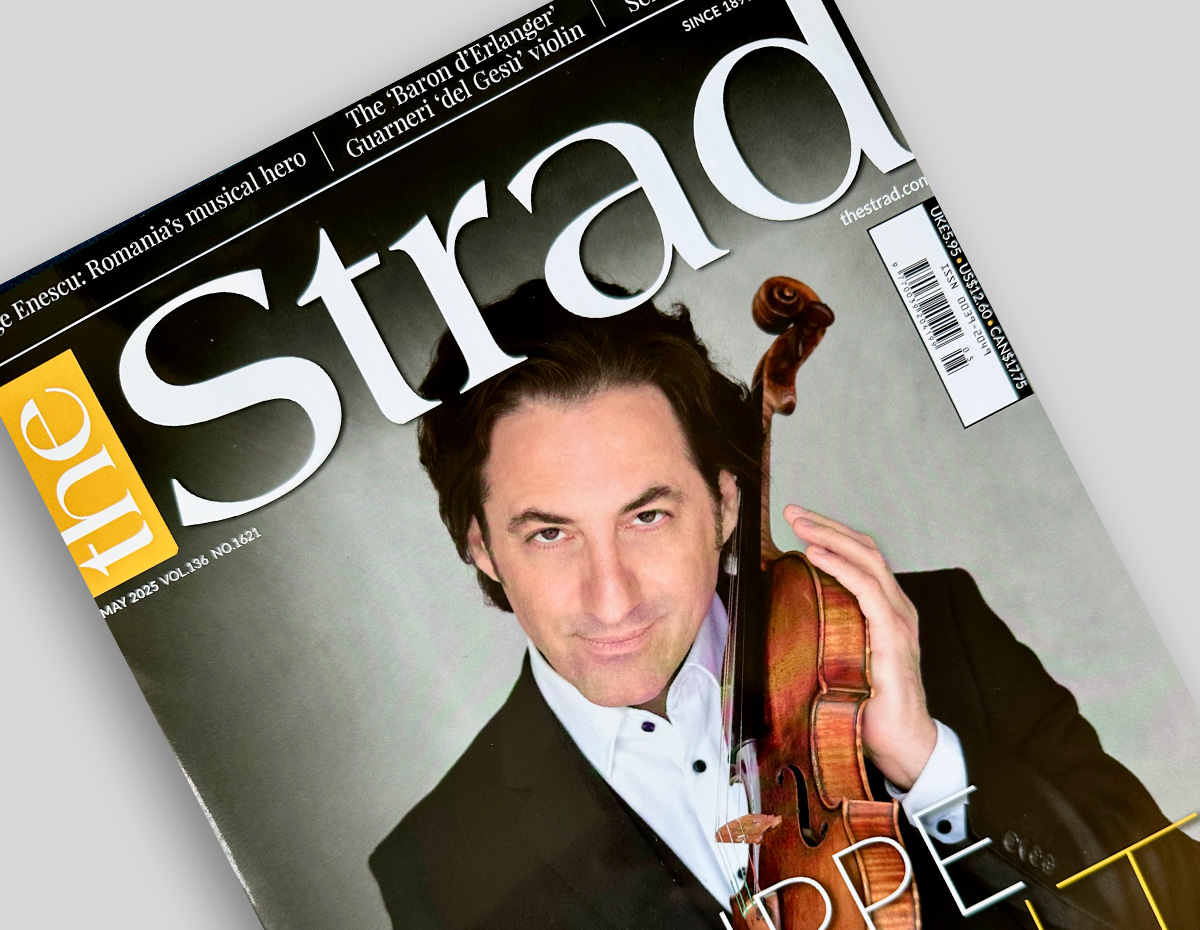
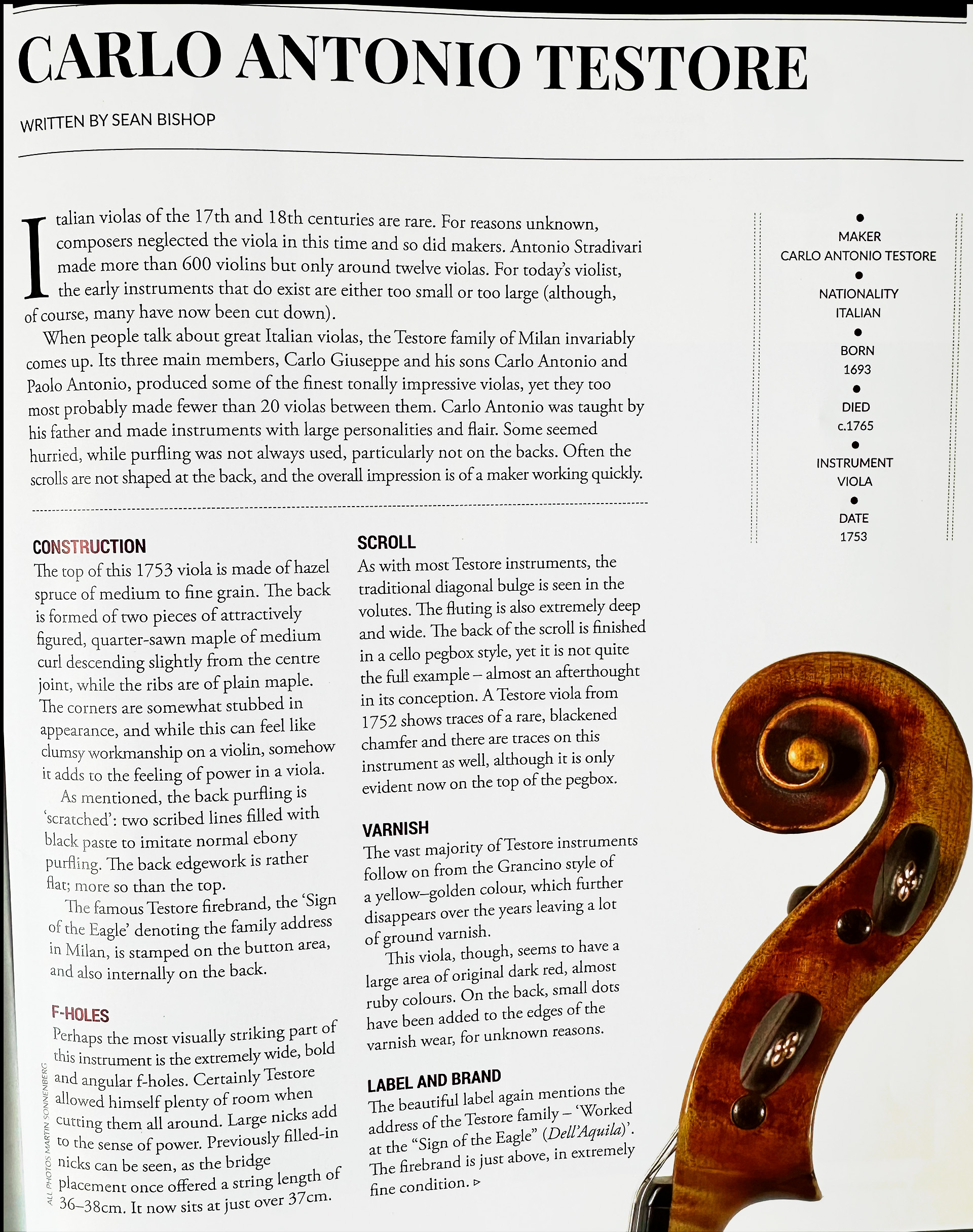
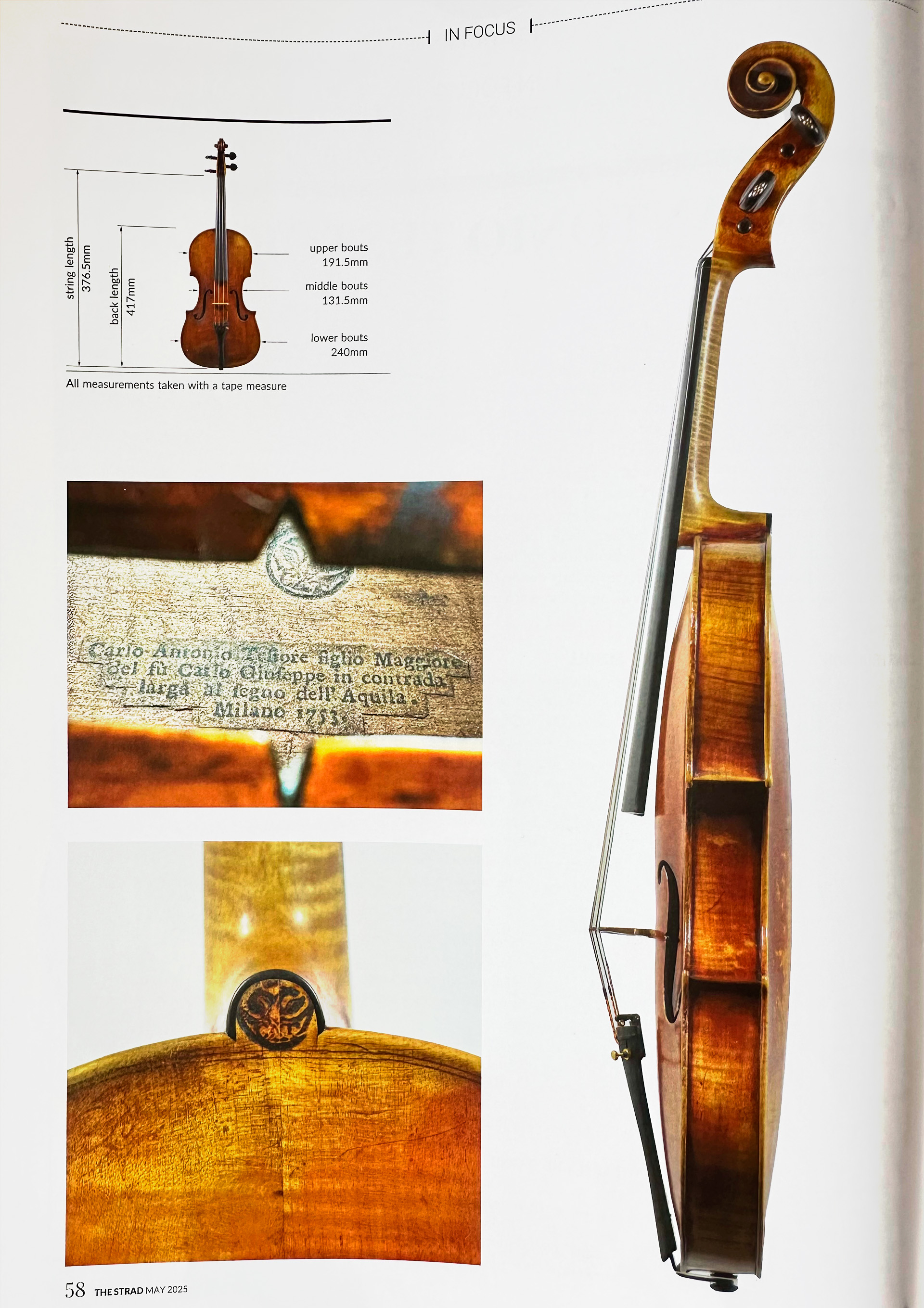
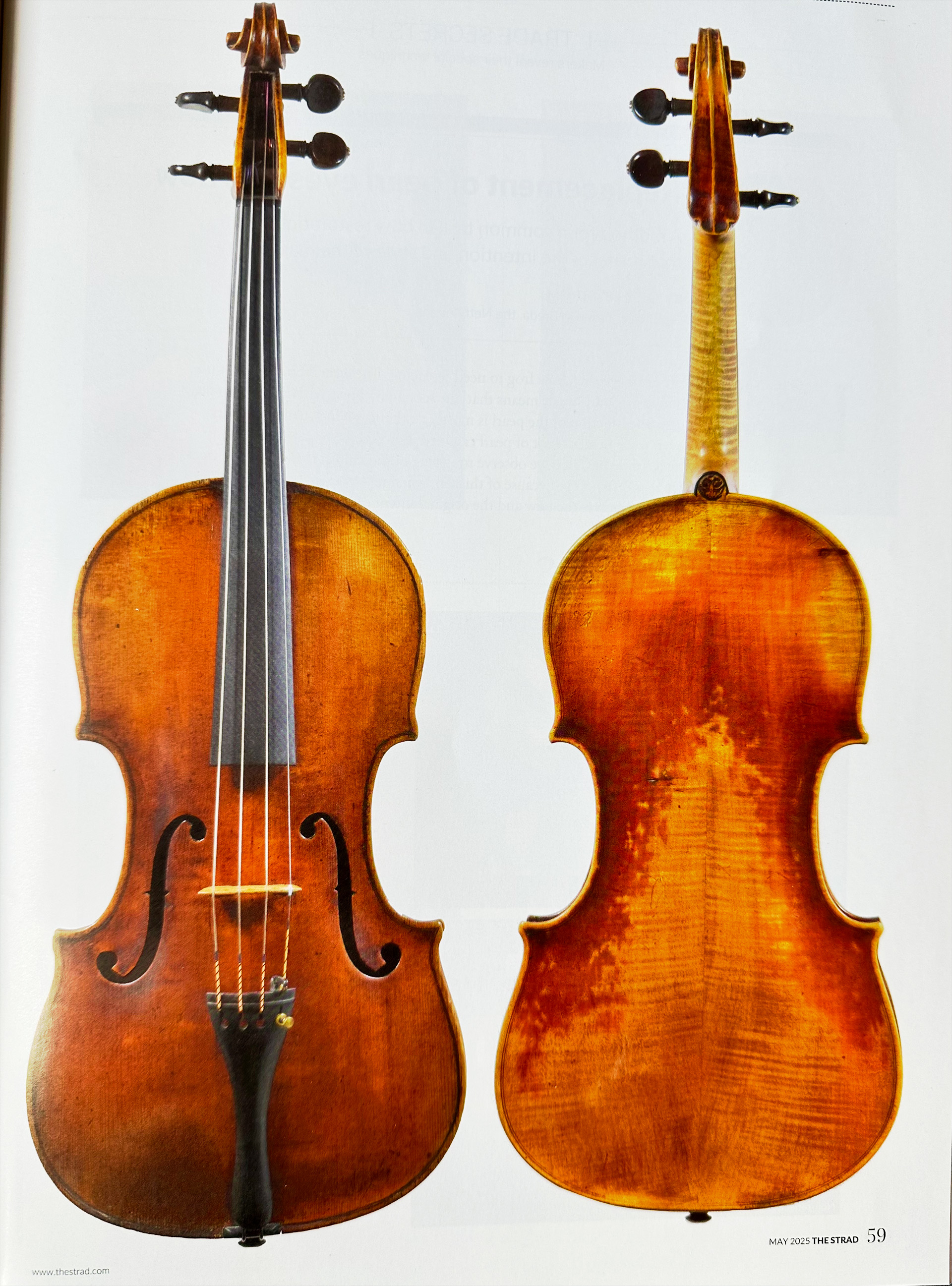
Italian violas of the 17th and 18th centuries are rare. For reasons unknown, composers neglected the viola in this time and so did makers. Antonio Stradivari made more than 600 violins but only around twelve violas. For today’s violinist, the early instruments that do exist are either too small or too large (although, of course, many have now been cut down).
A fine violin by Carlo Giuseppe Oddone, Turin, 1927 and 2 Sartory viola bows!

CG Oddone (1866-1935) is today regarded as one of the finest makers from Turin in the early 20th century (and late 19th). He studied with Benedetto Gioffredo-Rinaldi for 8 years, he then worked in London for a few before returning to Turin. His instruments are never antiqued and show a lot of personality.
This 1927 violin is a fine example of his later work. Made on a somewhat Stradivari model, yet his typical slighty clenched scroll with black chamfers, a one piece back..the overall feeling is power and beauty. While I used to love the Bologna makers…these days I have moved to Turin with the makers, Marchetti, Fagnola and Oddone. We are lucky to have examples of all these makers available.
Eugene Sartory is today regarded as the finest 20th Century bow maker. We are lucky here to have 2 examples of his fine viola bows. One, with a straight frog, is his early 1900/10 period…similar to Lamy, but perhaps with more visual power! The other bow, circa 1915 , is a typical example of his standard viola bow. Both these bows come from great backgrounds…one is ex London Symphony…the other 2nd generation French violin maker collection!
20 years in London……..

Arriving in London in 1992 to start post graduate viola studies at the Royal Academy of Music…I guess it was quite obvious my bigger skills would be elsewhere as in the first week of my RAM studies I had sold Violin Professor Eric Grunberg a very fine F.N.Voirin. Playing was my obsession, indeed my dream was always to play in a London Orchestra (having grown up in a small Australian country town!) but buying and selling instruments was already in my life.
After graduating in 1993 I was fortunate to immediately start working with all of London’s best Orchestras. This I did for 8 years…but always selling instruments and bows to my friends and colleagues. In about 1998 I realised my dream was a shop! , not an Orchestra. So I spent more time trying to learn and deal!
In 2002/3 I closed the viola case and went full time. I was never sure how I could leap from dealing at home to an actual premises but in 2004 I was offered a nice small studio in Mayfair, South Molton street on the 3rd floor. It was affordable. Just. We set up, polished the floors, painted the walls and bought a desk! I found a great old bookcase I converted into an instrument hanger…I still use it today!


We stayed at 42 South Molton st only for a year as the roof started leaking and It was time to move really. …….just across from number 42 was number 18!
A bigger shop, office for me, showroom and a small workshop. Business continued on an upward projection, and I was able to get my first P.A, Lisa Rattray, wife of the RAM’s instrument custodian, David! And then Alexandre Valois started working 3 days a week or so as my in house restorer. I had also Michael Shakespeare as my main restorer since the 1990’s…he probably worked 2 days a week for me for 20 years… he was one of the quickest and most able restorers I have ever met, and it was always nice to visit him in his Blackheath workshop or later on when he would visit us with a collection of restored instruments.

In 2010 my 5 year shop lease was up and the shop owner wanted it back so I was on the hunt again. I first saw 2 Hinde street on a brochure, dismissed it as far to expensive for me and was busy looking elsewhere. I found a new place near Oxford circus…but the “legals” seemed to be dragging on so thought I had better have a B plan.

Back to 2 Hinde Street….it was Love at first sight! So I did it. What was an old Spanish travel agent became my home for the next 11 years. I spent a small fortune kitting it out and off we went. I held “Cremona Violin Making “ Exhibitions every second year, we did 1 or 2 masterclasses a year in shop with great visiting artists… And I sold many instruments including Stradivari, Montagnana, Guadagnini, Gagliano, Vuillaumes etc etc

It was a great place to be.
In 2020, the pandemic hit, and while I rode the storm ok, I was wondering did I want a different place. So in June 2020 I found 92/93 Great Russell st and we fitted it out and moved January 2021. I love GRS and expect this to be my last shop. It feels like home.
Some numbers…..
2004-2024…….
Started with 4 instruments and 10 bows…the rest consignment.
Now…I own 140 instruments and 250 bows…..no real need for consignments.
Around 2000 sales.
I am lucky to do a Job that I love.
Thank you for the 20 years….let’s get another 20!
Instrument & Bow of the Month – February 2024
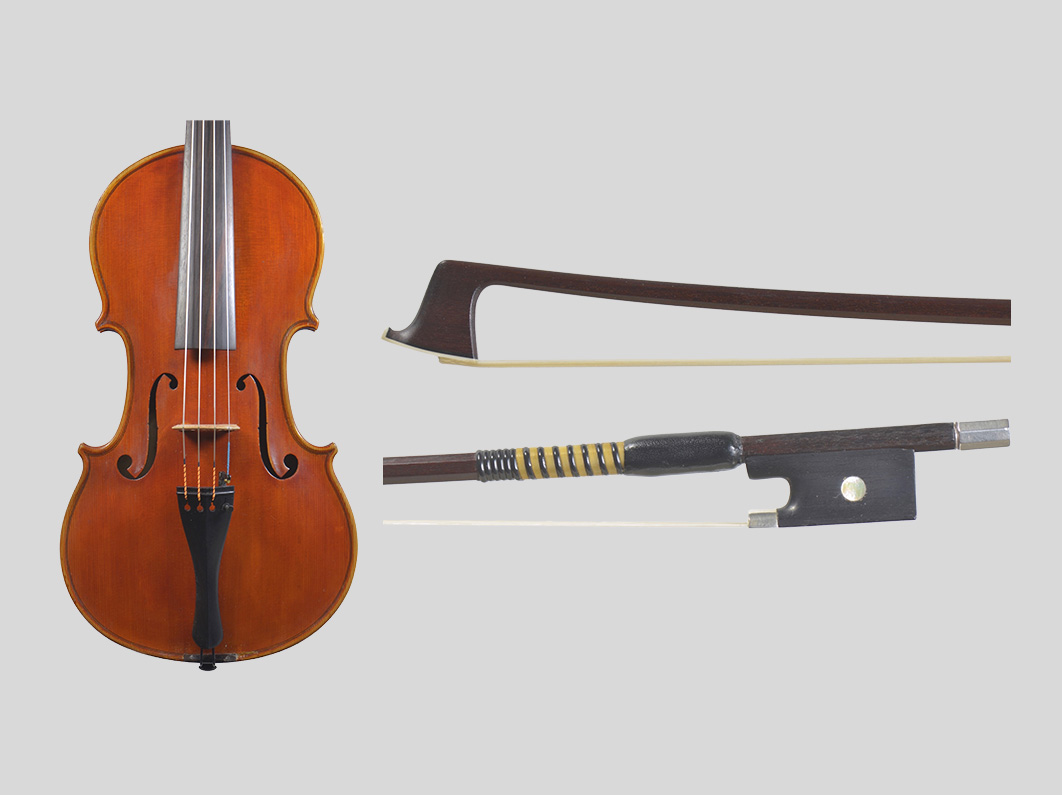
Piero Parravicini was born in Bovisio, just outside Milan, in 1889. He then moved to Milan to study with Romeo Antoniazzi and later worked in the Monzino workshop for one year in 1924 before setting up on his own. He had a successful career in his own right and was awarded medals in Rome in 1925 and 1929, Cremona in 1949 and Rome again in 1954.
Parravicini is in some ways typical of the Modern Italian school in that his instruments are unantiqued. His work demonstrates the influence of the Antoniazzi family, particularly in his use of Classical Italian models with a rich orange varnish.
Parravicini died in 1957, having made around 600 violins as well as 10 violas, 12 cellos and 3 double basses. A prolific and very fine maker whose instruments deserve greater attention! I have always been interested in this maker as his work shows a high level of skill and real refinement. We are lucky to have 2 violas and especially the 2 violas here in the shop.
As for the bows…well, Emile August Ouchard can be regarded as one of the finest makers of the 20th century. He is a maker I love, probably more than Sartory, as you feel it’s one maker doing his thing! Sartory had too many workers, and although the end result is special…I prefer the one man and his tools approach!
This EAO viola bow is special. FX Tourte copy. I remember when it was for sale in the 1990’s whilst I was still a musician. It’s price was around £7000……Sartory viola bow were £8000. And sadly out of my reach, But I already owned a fine Lamy so probably didn’t need it! A colleague bought it and now I am selling it.
The EF Ouchard is actually as good as an early EAO…if you get my drift. Elegant and still strong. It’s tough when the kids start getting better than the parents…but isn’t that what we want from our kids anyway?
Come and try these fine violas and bows………..
Instrument & Bow of the Month – August 2023

William Prior ( Born 1690 Gateshead, died 1759 Newcastle, County Durham UK) is an extremely interesting and rare UK maker.
I have seen a few violins by him but this is the first viola. Who did he learn off? no idea? how many instruments? no idea.
You see what I’m up against!
Certainly he must have known the other great British maker of the time, Daniel Parker as this viola show too much skill to be a self taught or at least someone whom has a deep understanding of making (that Parker had).
The main thing to get excited about with this viola is it’s size. No baby 15″ back like you see in so many early English instruments. This is a full, grown up instrument.
The last great English viola by Parker sold at auction for £220 000.
I think I’m being reasonable at half this price £110 000.
The viola will come with a letter from John Dilworth.
LOB 41.7cm
James Tubbs (1835-1921)was one of the finest and most prolific bow makers in the history of British violin making. His work rivals that of the finest French makers, and he is said to have made thousands of bows in his lifetime. Initially Tubbs trained with his father William before starting his own business in the 1850s. He collaborated with William Ebsworth Hill starting around 1858, but never appears to have been officially employed by Hill or the Hill firm. In fact, after their relationship deteriorated steadily and eventually foundered in 1870, whenever Tubbs came across an example of his own work bearing a Hill brand, he stamped his own name on top of it, either ” J. Tubbs” or “Jas Tubbs.”
Tubbs’ work is widely sought-after and has been copied and forged by makers ranging from French and German trade workers and Bazin families. The sticks of his bows are usually round and the metal parts are of generous thickness.
This bow is a very fine example of his “own style” work. Perfectly balanced, strong and excellent condition, for less than half the price of a Sartory you will find a bow that produces more colours and a better tone on your viola.
We have 3 Tubbs viola bows in stock
Instrument & Bow of the Month – July 2023

Giuseppe Sgarbi (1818-1905) A talented luthier who spent much of his life in the city of Modena, Italy, Giuseppe Sgarbi was perhaps one of the last true 19th century makers before “Modern” Italian violin making. Sgarbi’s work is renowned for being high in skill with fine workmanship – something he later taught his son, Antonio.
A unique yet traditional style
Much of Sgarbi’s work was classical in design and inspired by the Cremonese tradition, but he was not afraid to add his own personal flair. Many of his instruments would feature unique characteristics such as decorative designs, which added a vibrancy to his work. A highly accomplished Italian maker, Sgarbi’s violins, violas and cellos are highly sought after by musicians, collectors and investors today.
This viola is typical example of his refined work. Although just over 16”(40.8cm) back, this viola still has the punch of it’s C string tone.
I have actually been playing it for the last year myself! (Leading the viola section of the Windsor & Maidenhead Symphony Orchestra)
The last Sgarbi viola I had was sold to the Hungarian State Opera House Orchestra!
The viola comes with a recent certificate of Eric Blot.
Louis Gillet viola bow, made Paris C1945/50
Gillet served his apprenticeship , as typical with most French makers of the time, in the city of Mirecourt. He eventually set up his own workshop in 1924. From 1934 he started working for and with Eugene Sartory until the masters death in 1946. Of course his work from this period and beyond is heavily influenced by Sartory and this bow is an example of this!
Stamped Sartory a Paris…twice (under the lapping as Sartory did) this bow was probably sold as an original. Yes, it’s that good! 72 grams strong, and still half the price of his master!
Instrument & Bow of the Month – June 2023
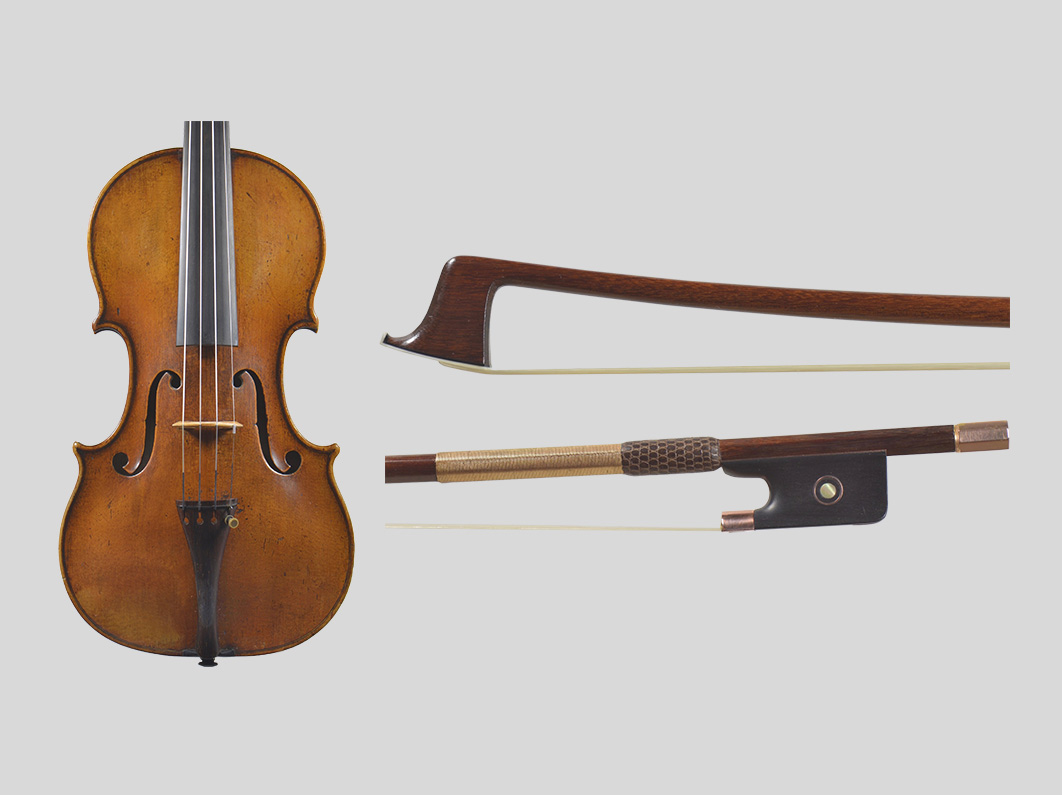
This month, immerse yourself in the world of masterful instrument craftsmanship with two exceptional pieces. First, an Italian violin by Andrea Guarneri, crafted in 1694, boasting a seamless collaboration as English maker John Betts replaced its damaged table around 1790. This remarkable composite instrument showcases their combined artistry and comes in impeccable condition, cherished by a renowned UK concertmaster. Certificates from Charles Beare and W.E.Hill & Sons affirm its authenticity. Accompanying this treasure is a rare bow by Émile Auguste Ouchard, born in 1900. Crafted between 1930 and 1935, this rose gold masterpiece epitomizes Ouchard’s refined style and holds immense collectability. With a Raffin certificate as testament, this bow encapsulates the renowned bowmaker’s legacy.
A Violin By Andrea Guarneri, C1694 – Table By John Betts
Extremely fine Italian violin made by Andrea Guarneri in Cremona 1694, obviously the table suffered some damage and was replaced by the great English maker, John Betts c1790. So often with these composite instruments you get a top that is found to try and fit the body of the instrument…so it’s nice to see in this instance a great maker of the past making a top in the style of the body to fit!
Condition is very good and any restoration done has been first class.
This violin is the property of one of the UK’s finest concertmasters and he has performed in Proms and concertos on this violin for the past 15 or so years.
Certificates from Charles Beare and W.E.Hill & Sons.
A Violin Bow By E. A. Ouchard, Gold Mounted
Émile Auguste Ouchard was born in Mirecourt in 1900. He started studying bowmaking at the age of 13 with his father, Emile Francois Ouchard. At the time Émile François worked out of the workshop of Eugene Cuniot Hury. After 10 years, the father and son opened their own workshop.
Auguste Ouchard’s work improved over the next decade and he started to distance himself from his father in terms of style and design. Eventually he moved to Paris to establish independently. Between 1938 and 1946 he worked in Paris, branding his work with his own label. In 1942 he won the Grand Prix at the 1942 International Paris Exhibition. At the coaxing of his associates, Ouchard moved to New York City in 1946. He worked at the shop of Lazare Rudié in New York until 1948. Then he was invited to work as an executive at the William Lewis & Son firm in Chicago. Later he moved back to New York, and then finally back to Paris where he spent the rest of his life.
This is an extremely fine example of his most refined work of 1930/35. Beautiful rose gold. Raffin certificate.
Rare example. Highly collectable.
No Comments